
Research · 08.09.2026 · 12 хв · True Fungi
Lion's Mane and New Neural Connections: What the Science Shows
How Lion's Mane compounds affect neurite growth in the laboratory, what mouse studies found and why new connections in the human brain remain unproven.

Does Lion's Mane mushroom help the brain form new neural connections? In laboratory studies, isolated compounds from the mushroom increased the growth and branching of neurites, the projections made by nerve cells. Mouse experiments have also reported changes in neurotrophic signalling and memory tasks. Human trials, however, have not measured the creation of new synapses. An interesting biological hypothesis is therefore not yet a proven effect of an ordinary supplement in the human brain.
Коротко про головне
Lion's Mane contains compounds that have affected neurite growth and signalling associated with NGF and BDNF in cell and animal models. Small human trials have produced mixed results on cognitive tests, but have not directly shown the formation of new neural connections. Consult a doctor before using a supplement.
What the brain changes when it learns
Neuroplasticity is the nervous system's ability to alter its activity and organisation in response to experience. When someone practises a movement, learns a skill or recalls information, the network can change in several ways. Existing synapses may become stronger or weaker, the number and shape of contacts may change, and larger networks may coordinate differently.
The phrase “new neural connections” usually refers to new or remodelled synaptic contacts. It is not the same as the birth of a new neuron. Neurogenesis, the production of new nerve cells, is a separate process. Claims that a mushroom “grows brain cells,” lengthens neurites or improves a test score therefore describe different levels of evidence.
A neurite is not yet a working network
In cell culture, a neurite is a projection from a neuron that may later specialise as an axon or dendrite. A longer or more branched neurite shows that the cell responded to a set of conditions. It does not establish that a stable, functional synapse formed in a person's brain, joined a useful network and improved learning.
Why NGF and BDNF appear in the Lion's Mane story
Nerve growth factor (NGF) and brain-derived neurotrophic factor (BDNF) are proteins involved in the survival, development and plasticity of nerve cells. Researchers can test whether a compound changes activity in these signalling systems. That gives them a possible mechanism to investigate.
A mechanism in a dish is not a finished answer for a customer. Scientists must also determine whether a compound is absorbed, reaches the relevant tissue in a useful amount, remains active and produces a meaningful outcome without unacceptable risk. The phrase “supports NGF” on a label does not answer those questions.
What cell studies found
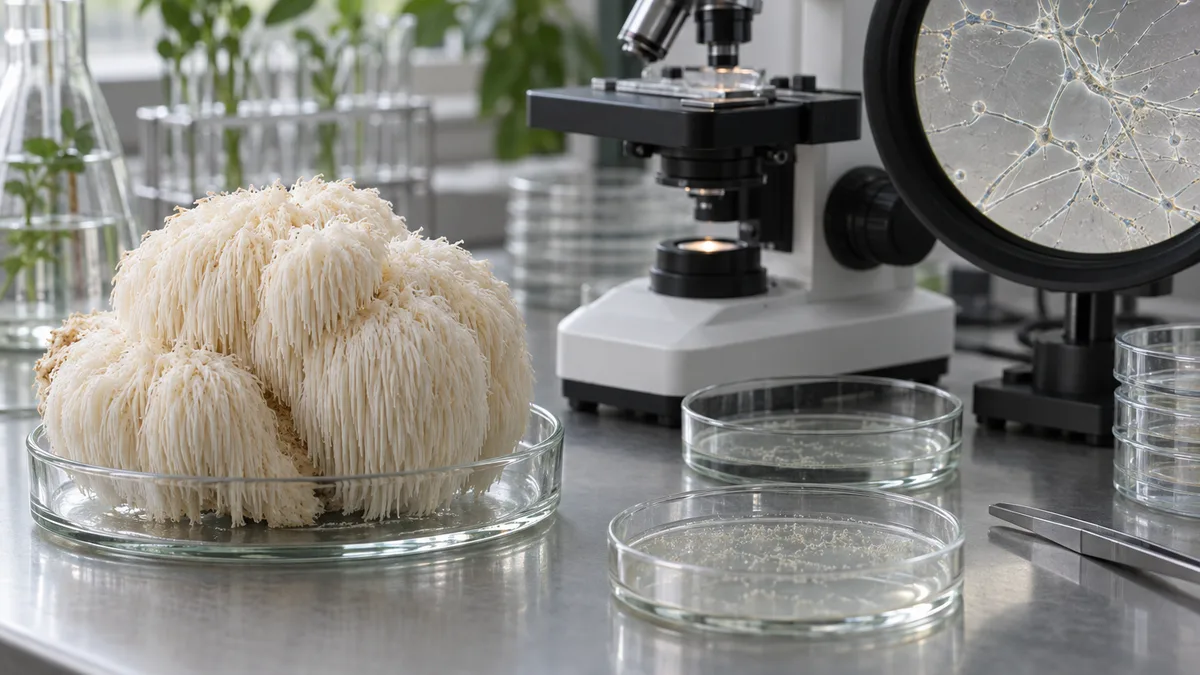
In a 2014 study by Phan and colleagues, researchers isolated hericenones from Lion's Mane fruiting bodies and tested them in PC12 cells. This rat adrenal tumour cell line is commonly used as a model of neuronal differentiation. The hericenones did not produce neurite growth on their own under the conditions used. With a low concentration of NGF present, they enhanced the neuritogenic response; the authors examined hericenone E and the MEK/ERK and PI3K/Akt pathways in particular.
This distinction matters. The experiment involved neither a human brain nor ordinary nervous tissue. It demonstrates possible biological activity of specific isolated compounds under controlled conditions.
A separate 2023 study by Martínez-Mármol and colleagues examined purified N-de phenylethyl isohericerin (NDPIH) and its derivative hericene A. They promoted axon growth and neurite branching in cultured hippocampal neurons. The effect converged on ERK1/2 signalling and was only partly dependent on TrkB, the receptor through which BDNF acts.
What mouse experiments added
In the same 2023 paper, mice received a crude Lion's Mane extract or hericene A for 31 days. The researchers reported changes in neurotrophin expression and downstream signalling, together with better performance in selected memory tasks. This is a stronger step than a cell culture because a substance must pass through digestion and metabolism and act within a whole organism.
A mouse is not a small human. Doses, metabolism, behavioural tasks and the experimental setting differ from everyday supplement use. The work was also supported in part by CNG-Bio. Commercial funding does not invalidate a finding, but it belongs in the context readers use to judge the evidence.
What human trials actually measured
Human trials have mainly assessed memory, attention, task speed or mood. They did not count new synapses or produce images showing that new connections formed after supplementation.
| Study | Participants and duration | What the result means |
|---|---|---|
| Mori, 2009 | 30 adults aged 50–80 with mild cognitive impairment; 16 weeks | One cognitive scale improved during use and fell after supplementation stopped |
| Saitsu, 2019 | Double-blind, 12-week adult trial | A difference appeared on MMSE, but not across all three tests |
| Docherty, 2023 | 41 healthy adults aged 18–45; acute dose and 28 days | A signal on Stroop speed appeared alongside null and limited negative findings |
| Surendran, 2025 | 18 healthy adults aged 18–35; one dose | No significant effect on composite cognition or mood measures |
The small trial by Mori and colleagues is often cited as human confirmation. It was randomised and placebo controlled, but included only 30 people with a specific diagnosis. An improvement on a cognitive scale does not reveal which cellular mechanism caused it.
In the 2023 pilot study by Docherty and colleagues, performance was quicker on one Stroop measure 60 minutes after a dose. A reduction in subjective stress after 28 days remained a trend at p = 0.051. The authors urged caution because the sample was small and the findings included null and limited negative results. A 2025 study by Surendran and colleagues found no overall improvement in cognition or mood after a single dose in 18 young adults.
The evidence ladder and the missing step
A cell experiment asks whether a compound can affect cell projections under particular conditions. An animal model asks whether a signal persists in a whole organism. A clinical trial asks whether an outcome that matters to people changes. Direct evidence of new neural connections in humans would require validated measurements of network structure or function and replication by independent groups.
Lion's Mane has interesting evidence on the early steps and several small human trials. A gap remains between them. It is reasonable to say that the mushroom is being investigated as a possible modifier of neurotrophic processes. It is too early to say that it has been proven to grow new connections in the human brain.
Why the form of the product matters
“Lion's Mane” on a label does not describe one standard preparation. Fruiting body, mycelium, powder and extract differ in composition. Cultivation and extraction also change the chemical profile. Hericenone E in a cell experiment, purified NDPIH, crude extract given to mice and powder used in a human trial are not interchangeable.

Before choosing a product, check the Latin species name, the part used, the form, full ingredients, suggested serving, manufacturer and available quality documents. Do not copy a research dose to another product merely because the mushroom name matches.
A practical conclusion for focus and learning
If your goal is learning or concentration, turn it into an action: perhaps working for 25 minutes without switching tasks or reviewing new material at a set time. Sleep, regular movement, repetition and gradually increasing the challenge create conditions in which the brain adapts to experience. A supplement cannot replace those behaviours.
True Fungi's Focus goal page can help you navigate product descriptions. It does not establish that Lion's Mane is necessary for a particular person. If you decide to consider a supplement, show your doctor the exact label and a list of medicines and other products you use.
Memorial Sloan Kettering notes abdominal discomfort, nausea and skin rash reported in a clinical study. Evidence is insufficient for a universal regimen. Pregnancy, breastfeeding, use in children, mushroom allergy and planned surgery require individual medical advice.
Questions about Lion's Mane and neural connections
Does Lion's Mane grow new neurons in the human brain?
This has not been directly demonstrated. Laboratory studies show neurite growth in cell models, but a neurite in culture is not a new functional neuron or synapse in a person's brain.
How is neuroplasticity different from neurogenesis?
Neuroplasticity includes changes in the strength, structure and activity of existing networks. Neurogenesis means the production of new neurons and is a separate process.
Does an NGF claim prove that a supplement works?
No. NGF can help researchers investigate a mechanism, but evidence is still needed for the exact preparation, its availability in the body, clinical effects and safety.
Does Lion's Mane improve memory in healthy people?
The trials are small and mixed. Positive signals sit alongside studies without an overall improvement, so a reliable benefit for a healthy person cannot be promised.
How long should Lion's Mane be taken to form new connections?
Research has not established such a timeline. A study's duration is not a countdown to an individual effect, and these human trials did not measure the formation of new connections.
Головне
- Specific Lion's Mane compounds have promoted neurite growth in cell models.
- Mouse results cannot automatically be transferred to the human brain.
- Human trials measured cognitive performance rather than the creation of new synapses.
- Product form matters; consult a doctor before use.
Готові спробувати?
Курс на 2 або 3 місяці — вигідніше: знижка вже врахована в ціні.